

Sauna basics
How Hot Should a Sauna Be? Sauna Temperature Guide
The normal sauna temperature range, where beginners should start, why most U.S. heaters stop at 194°F, how humidity changes the feel, how long a sauna takes to heat and how to stay safe.
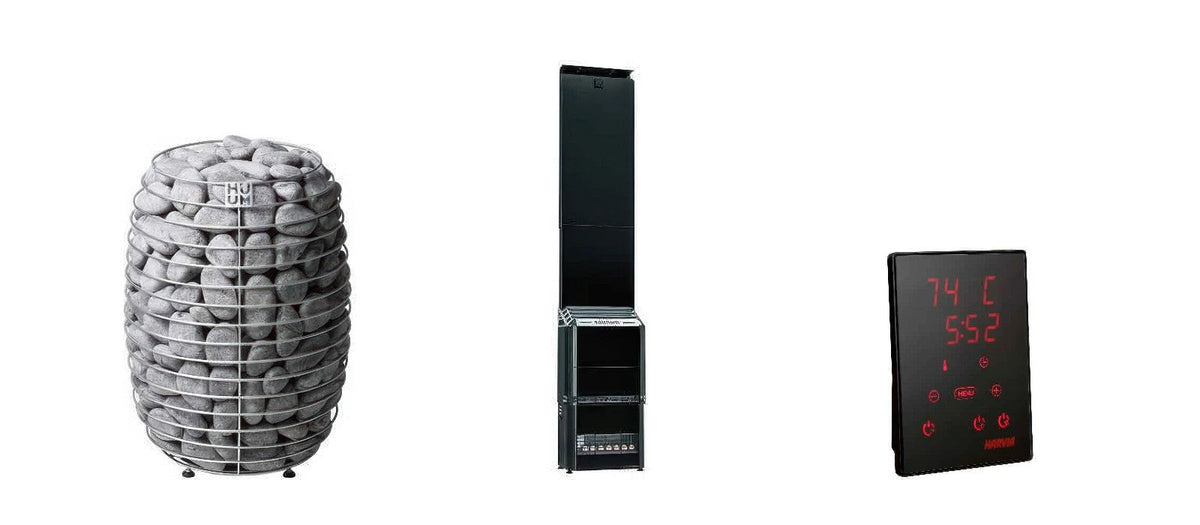
The short answerA traditional sauna usually runs between 150 and 195°F (65 to 90°C) with low humidity. Harvia, the Finnish heater maker, calls 160 to 185°F a normal sauna temperature, and HUUM suggests beginners start lower, at 140 to 158°F. Most U.S. sauna heaters stop at 194°F because the building code caps the thermostat there. Infrared saunas run much cooler, usually 110 to 135°F.
This guide covers the normal temperature range, where to start, how humidity changes the feel, how long a sauna takes to heat, and how to stay safe. It uses heater makers' manuals, the building code and health sources, all listed at the end, plus the specifications of the heaters and controls we sell as of October 1, 2026.
Normal sauna temperatures by type
"Sauna" covers a few different kinds of heat. The temperature and the humidity go together: the drier the air, the hotter the room can be and still feel comfortable.
| Type | Typical temperature | Humidity |
|---|---|---|
| Traditional (Finnish) sauna | 150 to 195°F (65 to 90°C) | Low, under 20% |
| Soft or humid sauna | 113 to 149°F (45 to 65°C) | 30 to 65% |
| Infrared sauna | 110 to 135°F (43 to 57°C) | Dry |
| Steam room | 104 to 122°F (40 to 50°C) | Up to 100% |
Traditional and infrared ranges are from Cleveland Clinic, the soft sauna from Tylö's sauna building guide, and the steam room from HUUM.
What temperature should you start at?
There is no single right number. Harvia's advice is to set the temperature so that you sweat while sitting on the bench and still feel comfortable. In practice:
- First sessions: 140 to 158°F (60 to 70°C), which is HUUM's suggestion for beginners, with breaks.
- Most regular users: 160 to 185°F (70 to 85°C), Harvia's normal range.
- Experienced users: up to the 194°F limit. HUUM says temperatures near 212°F are not for beginners or anyone with health concerns, and most U.S. heaters can't be set that high anyway.
For comparison, the large Finnish study that linked regular sauna use to longer life (published in JAMA Internal Medicine in 2015) found its men spent an average of 14 minutes per visit at about 175°F, according to Harvard Health.
Why most heaters stop at 194°F
The International Residential Code, which many U.S. states and cities adopt, says sauna heaters must have a thermostat that limits the room to no more than 194°F (90°C), and that they must meet the UL 875 safety standard. That is why most of the controls we sell top out there:
| Control | Setting range |
|---|---|
| Harvia Xenio CX170 (Wi-Fi) | 104 to 194°F |
| Harvia Fenix FX30 | 104 to 194°F |
| Saunum AirIQ Wi-Fi | Up to 194°F |
| HUUM UKU (Wi-Fi) | 104 to 230°F |
HUUM's current U.S. manual lists the UKU at up to 230°F, so a few newer heaters can be set higher. Which rules apply depends on the code your city or county has adopted, so check with your local building department if you plan to run above 194°F.
Humidity: why the same temperature can feel different
In a traditional sauna you control humidity by ladling water onto the hot stones. The Finns call the burst of steam löyly. HUUM's manual says that how often and how much you ladle sets the humidity and how hot the room feels. More water makes the same air temperature feel hotter.
Harvia explains how this changes with temperature:
- At 176 to 212°F (80 to 100°C), the air may feel dry even after you throw water, and the steam feels sharp.
- At 122 to 140°F (50 to 60°C), you can use plenty of water and the air feels humid and soft.
Pour a little at a time. Harvia's manual says one or two ladles at once, and HUUM suggests about 80 ml (under 3 ounces) per pour.
Only pour water on a heater built for it. Traditional electric heaters and wood stoves with stones are made for löyly. Infrared saunas are not, so never pour water on infrared emitters.
The higher you sit, the hotter it is
Hot air rises, so a sauna is always hottest near the ceiling and coolest at the floor. That gives you a built-in dial: sit on the upper bench for more heat and the lower bench for less. Beginners can start low and move up.
It is also why bench height matters when you build or buy. Harvia recommends 1,100 to 1,200 mm (about 43 to 47 inches) between the upper bench and the ceiling, so your head sits in the hot air without touching the ceiling.
How long a sauna takes to heat up
| Heater | Time to temperature (manufacturer) |
|---|---|
| Harvia electric heaters | Usually 35 to 45 minutes |
| HUUM DROP | Around one hour |
| Saunum Air | 45 to 90 minutes |
| Finnmark infrared saunas | Under one hour to 170°F |
Room size, insulation, glass and outdoor temperature all change these times. Most Wi-Fi controls let you start the heater from your phone so the sauna is hot when you get there.
How hot does an infrared sauna get?
Infrared saunas warm your body directly with infrared light instead of heating the air, so they run cooler. Cleveland Clinic puts them at 110 to 135°F. The Finnmark FD-1, FD-2 and FD-3 infrared saunas we sell can reach 170°F. For the full comparison of heat, steam, power and cost, see our guide to infrared vs. traditional saunas.
Staying safe at sauna temperatures
- Keep sessions short. Cleveland Clinic suggests about 15 to 20 minutes, and about five minutes when you're new. Harvard Health says no more than 15 to 20 minutes. Harvia's manual says not to stay longer than 30 minutes at a time.
- Cool down between rounds. HUUM suggests rounds of about 15 minutes or less, two or three times, with a cool-down in between.
- Drink water. Harvard Health suggests two to four glasses of cool water after each sauna.
- Skip alcohol. Harvard Health advises avoiding alcohol and medications that can affect sweating. The Finnish Sauna Society says up to half of the people who die in saunas were drunk.
- Ask your doctor first if you are pregnant or trying to conceive, have a heart condition, high or low blood pressure or epilepsy, take medication, or are over 65. Cleveland Clinic also advises against sauna use after a recent heart attack or stroke.
This is general information, not medical advice. If you have a health condition, talk to your doctor about what temperature and session length are safe for you.
Getting the temperature you want
A sauna only reaches its set temperature if the heater is big enough for the room. Heaters are sized by room volume, and glass, stone or tile walls count extra. Harvia says each square meter of glass or stone adds as much load as 1.2 cubic meters of room. Our sauna heater size calculator does the math for your room, including a glass door.
Browse every electric sauna heater, wood-burning stove and sauna control, or call us and we'll help you match a heater to your room.
Sources
- Plunge Into Saunas catalog: control setting ranges and heater specifications for Harvia, Saunum, HUUM and Finnmark, checked October 1, 2026.
- Cleveland Clinic, sauna benefits, temperatures and precautions
- Harvia, What is the correct sauna temperature?
- HUUM, What temperature should a sauna be?
- HUUM, DROP heater manual (U.S.)
- HUUM, UKU control user manual (U.S.)
- Saunum, Air heater manual (U.S.)
- Harvia, KIP heater owner's manual (normal temperature, ladling, session length)
- Harvia, The sauna heats up slowly
- Harvia, How do I select the correct heater power?
- Harvia, Choosing sauna benches
- Tylö, How to build a sauna (soft sauna range)
- International Residential Code section M1902, as adopted in the 2021 Seattle Residential Code
- Harvard Health, Saunas and your health
- Harvard Health, Sauna use linked to longer life, fewer fatal heart problems
- Finnish Sauna Society, Sauna and health effects


