Cold plunge
Cold Plunge Temperature: How Cold Should It Be?
How cold a cold plunge should be, how long to stay in and how often, what cold shock does in the first minute, who should check with a doctor, and how to set the temperature on your tub.
The short answerWater counts as cold below about 59°F (15°C). Cleveland Clinic suggests beginners start at 50 to 59°F, never go below 40°F, and keep sessions short: a minute or two at first and never more than five minutes. Harvard Health notes there's no agreed best temperature or time, so start warmer and shorter than you think, and only go colder as your body gets used to it.
This guide covers the temperature ranges, how long to stay in, how often, what happens to your body in the first minute, and how to set your tub. It draws on Cleveland Clinic, Harvard Health, Mayo Clinic Health System, the American Heart Association, cold-water safety groups and the tub makers we carry, all listed at the end. For choosing a tub, see the best cold plunge tubs.
Cold plunge temperature ranges
| Water temperature | What it means |
|---|---|
| Below 59°F (15°C) | Cold water. The RNLI, the UK's lifeboat charity, defines anything below 15°C as cold water that can seriously affect your breathing and movement. |
| 50 to 59°F (10 to 15°C) | The beginner range. Cleveland Clinic calls it a safe starting point, and Harvard Health says ice baths typically run 50 to 60°F. |
| 40 to 50°F (4 to 10°C) | For experienced plungers. University Hospitals says more experienced people may go as low as 40°F. |
| Below 40°F (4°C) | Too cold. Cleveland Clinic says to avoid going below 40°F. |
Harvard Health points out that there's no consensus on the best temperature, timing or duration. The studies it reviewed used water at 59°F or lower for anywhere from three to 20 minutes, and a 2025 review in PLOS One covered studies at 45 to 59°F (7 to 15°C).
How long to stay in
Advice varies, so here it is side by side:
| Source | Session length |
|---|---|
| Cleveland Clinic | A minute or two for beginners; never longer than five minutes |
| Icetubs (tub maker) | 30 seconds to a minute at first, then 1 to 2 minutes, then 2 to 3 minutes with experience |
| Mayo Clinic Health System | 30 seconds to a minute, working up to 5 to 10 minutes, in water at 50°F or colder |
| Harvard Health | A maximum of 15 minutes, with someone nearby |
Cleveland Clinic's five-minute limit is the most cautious, and it's the one we'd start with. Icetubs makes a useful point: regular sessions matter more than long ones.
How often
Cleveland Clinic suggests beginners plunge once or twice a week, and Icetubs says one or two sessions a week is enough for many beginners.
You may see "11 minutes a week" quoted online. It comes from a small 2021 study in Cell Reports Medicine of experienced winter swimmers, who spent an average of 11 minutes a week in cold water and 57 minutes in the sauna. That describes what seven experienced men did, not a recommendation, and the authors note the small sample as a limitation.
The first minute: cold shock
The moment cold water hits your skin, your body reacts on its own. The National Center for Cold Water Safety describes a huge involuntary gasp, very rapid breathing you can't control, and a sudden jump in heart rate and blood pressure. The RNLI says breathing can speed up as much as tenfold, and that these first effects pass in under a minute.
The American Heart Association quotes a researcher calling the first 10 seconds to a minute the most dangerous time.
Stay too long and the risk changes to hypothermia, which Cleveland Clinic defines as body temperature below 95°F. Harvard Health warns it can begin within minutes in water under 65°F.
Plunging safely
- Never plunge alone. Harvard Health says never take an ice bath without someone nearby, and the American Heart Association says never to do a cold water swim on your own.
- No alcohol. Cleveland Clinic explains that alcohol lets heat leave your skin faster. Kohler's guide warns that alcohol, drugs or medication can greatly increase the risk of fatal hypothermia, and Icetubs says not to plunge if you've been drinking, feel unwell or are extremely tired.
- Check with your doctor first if you have heart disease, high blood pressure, diabetes, poor circulation, peripheral neuropathy or Raynaud's, or are pregnant. Harvard Health says anyone with a heart rhythm disorder such as atrial fibrillation should avoid cold plunges.
- Measure the water. Kohler says to check the temperature with an accurate thermometer before you get in, because temperature controls vary.
- Get out if it doesn't feel right. Cleveland Clinic's advice is to start slowly and see what your body can tolerate before staying in longer.
This is general information, not medical advice. The research on cold plunges is still limited: Harvard Health calls it scant, and a 2025 review found small studies with few women. Talk to your doctor about what's safe for you.
What the research says so far
The 2025 PLOS One review pooled 11 studies with 3,177 people. It found less stress 12 hours after cold water immersion, and some improvement in sleep and quality of life, along with a short-term rise in inflammation right after. The authors note there were few randomized trials, small samples, and only one study that included women. Treat claims you see online with that in mind.
Setting the temperature on your tub
Every chiller we sell can hold the 50 to 59°F beginner range, and every one can go colder than Cleveland Clinic's 40°F floor, so set it by comfort, not by the lowest number on the dial:
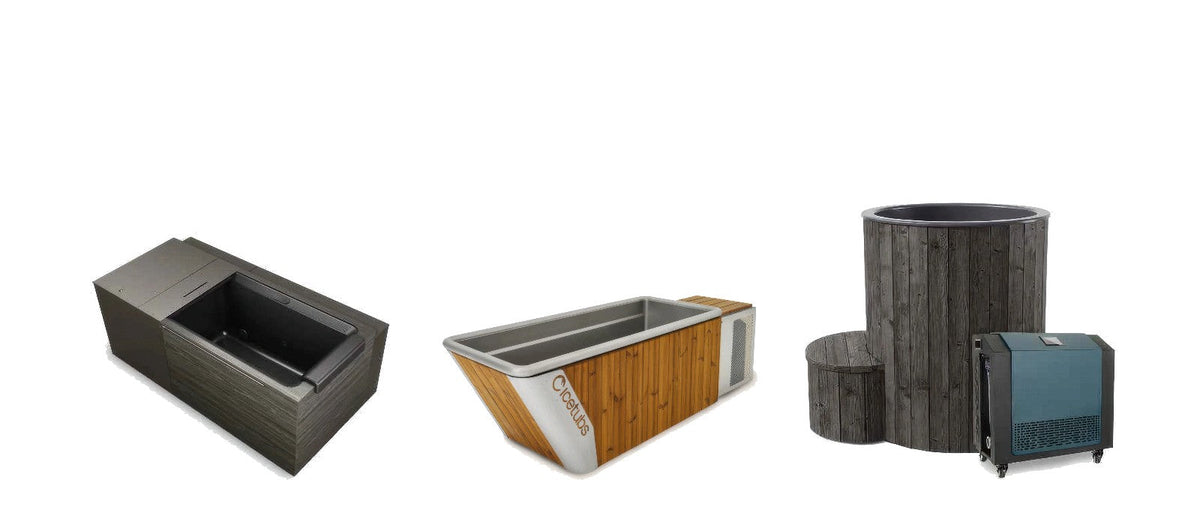
| Tub | Temperature range | Price |
|---|---|---|
| SaunaLife S1NC / S1BC package | 32.5 to 108°F | $5,340 / $5,540 |
| SaunaLife S2NC / S2BC package | 37 to 107°F | $7,120 / $7,320 |
| Finnmark SoulCold | 32.5 to 108°F | $6,990 |
| Icetubs IceBarrel, IceBarrel XL, IceBath | 37.4 to 100.4°F | from $9,995 |
| Kohler x Remedy Place Ice Bath | 39 to 104°F | $17,425 |
Because the temperature is adjustable, you can start at 59°F and step down a degree or two at a time as you get used to it. A few things help the chiller hold your setting:
- Keep the cover on. Kohler says to put it back after every use to keep the water clean and improve efficiency.
- Mind the weather. The FDC-1A chiller in the SaunaLife S1 packages is rated to cool in air from 59 to 109°F, while the AP-1 in the S2 packages works from 32 to 113°F. Kohler's Ice Bath heats the water on its own when the air drops below 40°F to stop it freezing.
For how chillers work and what they cost to run, see cold plunge chillers explained.
Browse every cold plunge tub, or call us and we'll help you pick one for your space and climate.
Sources
- Plunge Into Saunas catalog: prices and chiller temperature ranges for SaunaLife, Finnmark, Icetubs and Kohler cold plunge tubs, checked October 15, 2026.
- Cleveland Clinic, What to know about cold plunges
- Cleveland Clinic, Hypothermia
- Harvard Health, Can ice baths improve your health?
- Harvard Health, Cold plunges: healthy or harmful for your heart?
- Mayo Clinic Health System, Cold plunge after workouts
- University Hospitals, Taking the polar plunge
- American Heart Association, You're not a polar bear
- RNLI, Cold water shock
- National Center for Cold Water Safety, Cold shock
- Cain et al., Effects of cold-water immersion on health and wellbeing, PLOS One, 2025
- Søberg et al., Altered brown fat thermoregulation and enhanced cold-induced thermogenesis in young, healthy, winter-swimming men, Cell Reports Medicine, 2021
- Kohler x Remedy Place Ice Bath Homeowner's Guide
- Icetubs, How to use a cold plunge tub safely
- Icetubs, How long to stay in an ice bath